
Being a francophile and linguist, I’m something of a Guillaume le Conquérant fangirl.
I discovered, soon after moving here, that the verrrry old abbatiale (the actual church part of an abbey, which has lots of other buildings) in Bernay was founded by his grandmother, Judith de Bretagne (982-1017). When she married Richard II, Duke of Normandy, her dad (Conan) gave her a chunk of land on which she founded the abbey. The town of Bernay grew up around it.
Bernay’s own shabby chic basilica, Notre-Dame de la Couture* is where she’s buried.
Or is it…?
There are always things going on at the Musée des Beaux-Arts and around town: lectures, spectacles, crafty stuff for little kids, fun things for teens, outdoorsy family activities…
I’m always attracted to the teen things at the museum, so I finally just did one. (The French think Americans are all just overgrown children anyway. I wouldn’t want to disappoint.)
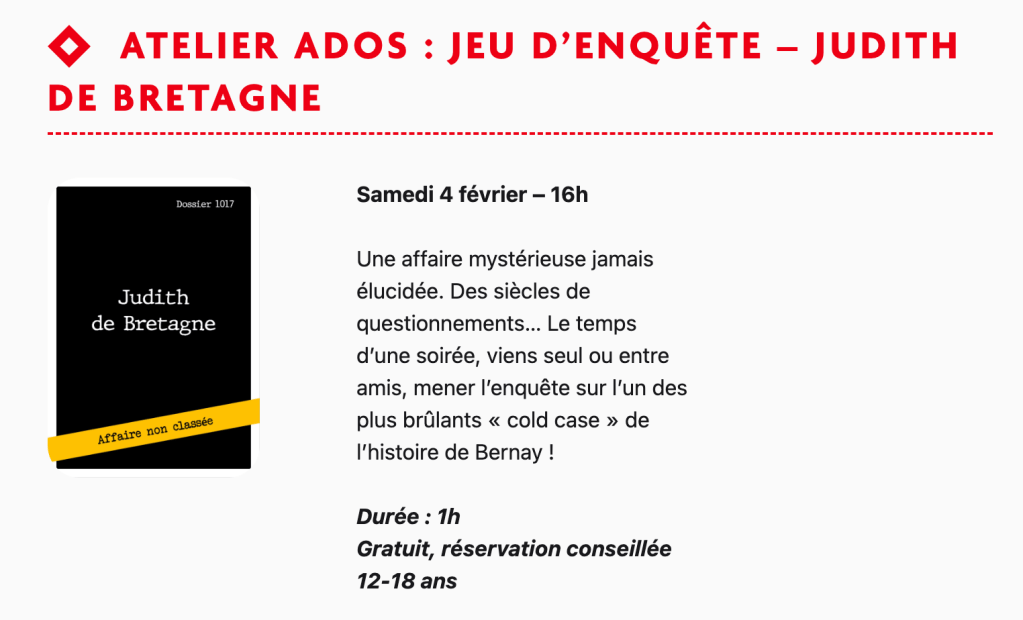
We met at the musée. The job of us enquêteurs (moi and a 13 year-old boy and about 9 people between 2 and about 60 who may all have been related to him) was to determine if the body currently buried at the basilica is indeed that of Judith de Bretagne. We were given a series of fascinating facts and theories and expected to make a decision based on all of these clues. 🧐 The concept and activity were the brainchild of Madame Lambert, the very creative Médiatrice culturelle of the musée.
Construction of the abbatiale started around 1013. A thousand and ten years ago. 😳 Judith’s wish was to be buried in it, but she died only a few years after work began. Nobody knows how much of the building was done by then, so we can’t know if she got her wish at the time of her demise. Unlikely. But if she had, she would have been buried in the coeur of the abbatiale, the top of the cross where only founders and abbots were usually buried.
The abbatiale was deconsecrated after La Révolution (1789). In 1861, Léon Le Métayer Masselin an archéologue, among other things, decided to go looking for JdB’s tomb in the abbatiale. There, he discovered her ledgerstone and a lead sarcophagus. Both are on display in the Musée des Beaux-Arts in Bernay (pics below).
Upon finding these artifacts, they decided to have a look inside the sarcophagus to see if it was really her. Six Bernay doctors examined the pelvis to determine whether it belonged to a woman. One of them drew a very bad picture of it (below). We enquêteurs were shown this drawing alongside much better drawings of the female pelvis and asked to decide if we could tell whether the doctor had drawn a female pelvis.
There were differing opinions on whether it was actually JdB (for the reasons further down). So two doctors from the Faculté de médecine in Paris were called in. One of them, Dr. Denonvilliers, got to make the final determination. He said it was indeed the pelvis of a woman and that she had a hip deformity that would have caused her to limp and made her souffreteuse (frail). But he wouldn’t go so far as to confirm that it was JdB. Frankly, though, how frail could she have been? She had five kids.
(Souffreteuse has now been added to my list of favorite words because I am also un peu souffreteuse. Previous favorite word learned in Bernay: rageurs.)
Scattered among our clues were some of the inconsistencies that gave these archeologists and men of science pause back in the day:
First, the deformity. JdB had been described by some author whose name I can’t find (because it’s buried behind a paywall on Paris Normandie) as “parfaitement belle de corps et recommandable par toutes sortes de bonnes qualités.”
But was she really? Was this guy just being sycophantic? Trying really hard to avoid lèse-majesté? Do you find it suspect that he should make a point of describing her as physically perfect? Protesting too much, much?
Both JdB’s father and her great-grandson (son of William the Conqueror) happened to have this very same trait… Coincidence? Well, yeah, could be, actually, given that there was (and still is) a congenital hip deformation among Bretons.
Then there’s the sarcophagus. Lead sarcophagi of this type were typical of the 17th century, but not of the period when JdB died.
However, a certain Pierre-Victorien Lottin de Laval (pic below), a local archeologist and savant (that’s old for intello) who was present at the examination of the skeleton in 1861, said that lead sarcophagi were not unheard of even in JdB’s time. Plus, there’s always the possibility that she could have been found somewhere on the grounds and transferred to this sarcophagus hundreds of years later and moved into the abbatiale then. Either way, it could be her in there…
In 1862, after the forensic investigation, they moved JdB to the basilica (which wasn’t a basilica till the 1950s).
At the end of the enquête, we were all asked to vote whether we believed JdB is now buried at the Lady of Sewing Basilica. We all decided she was. It was tons of fun!
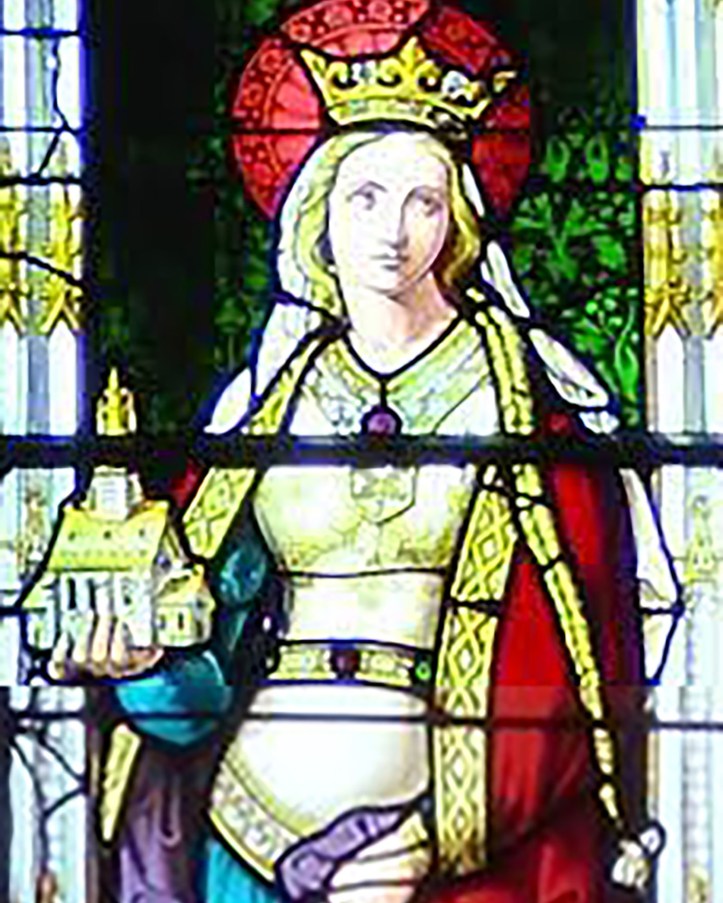
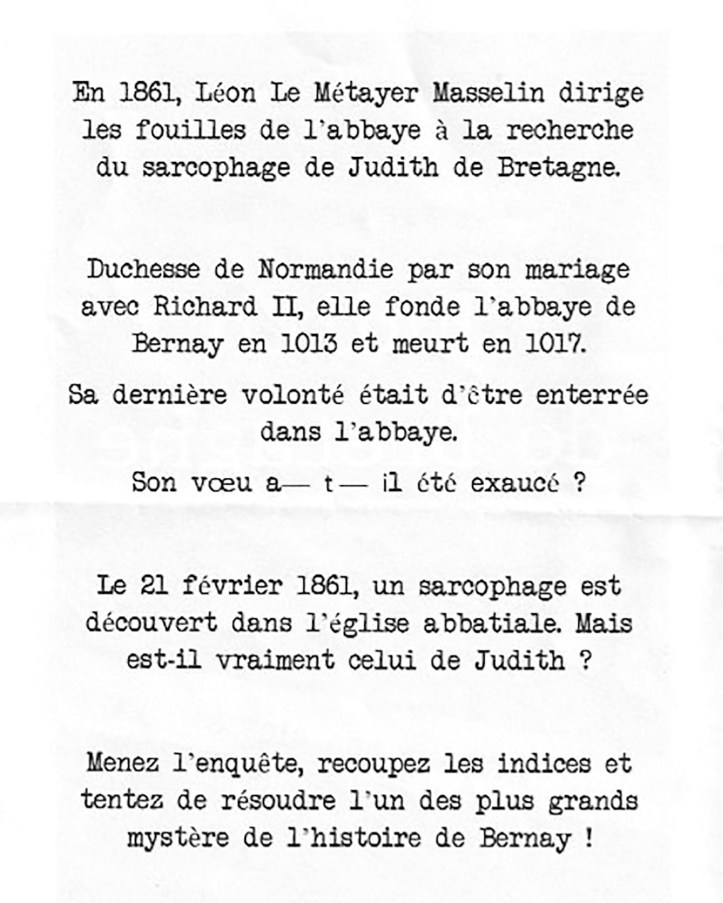
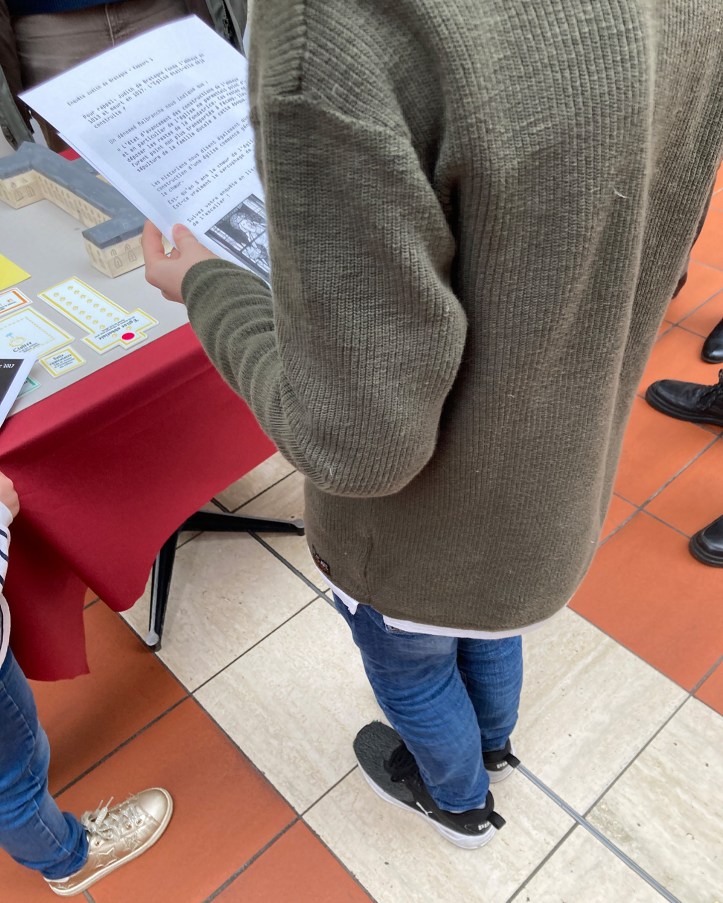
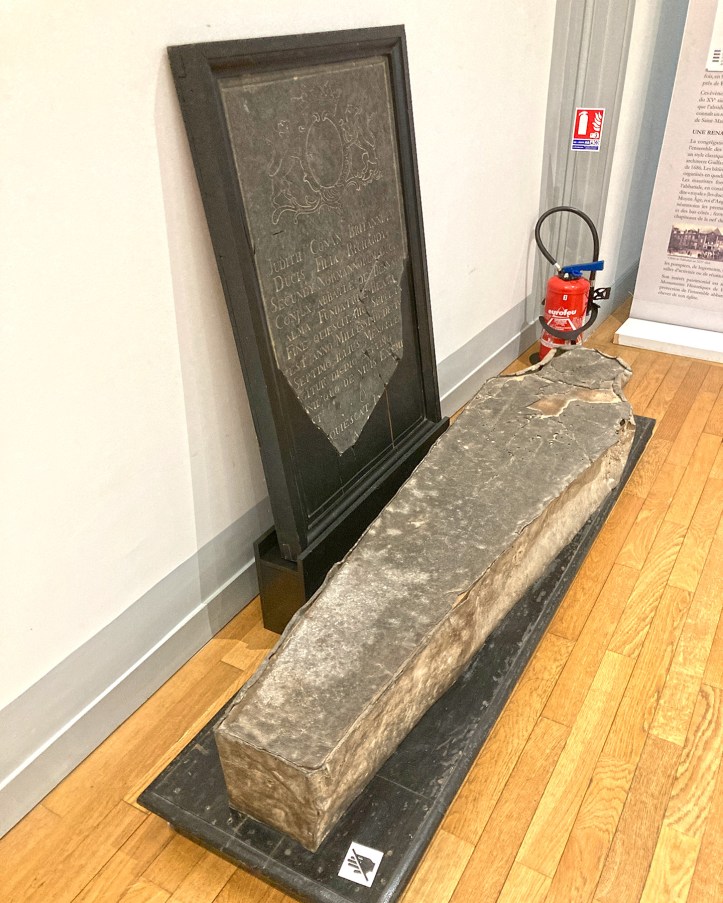
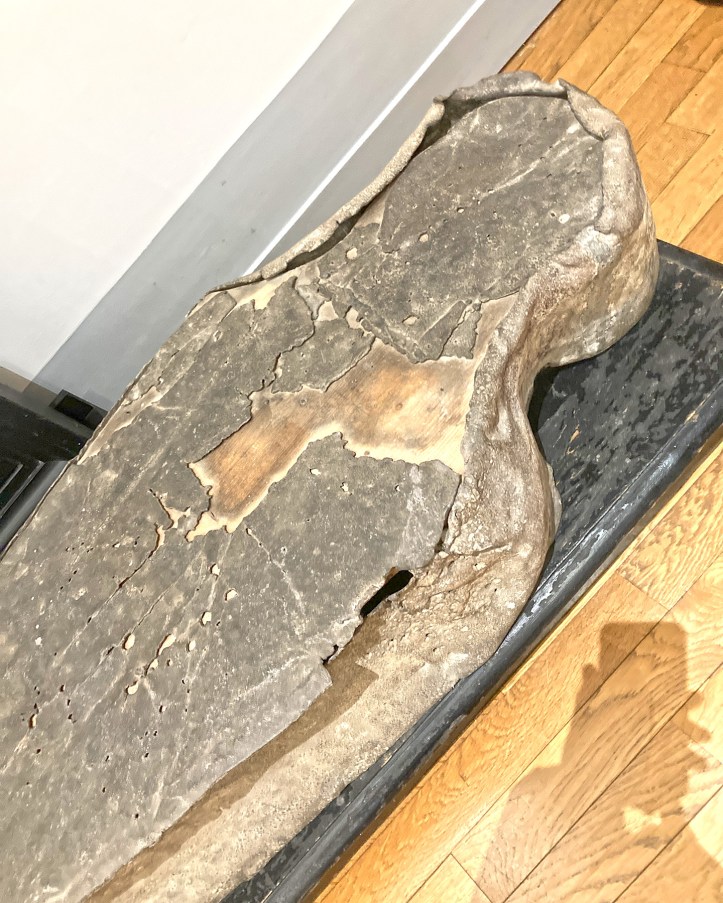
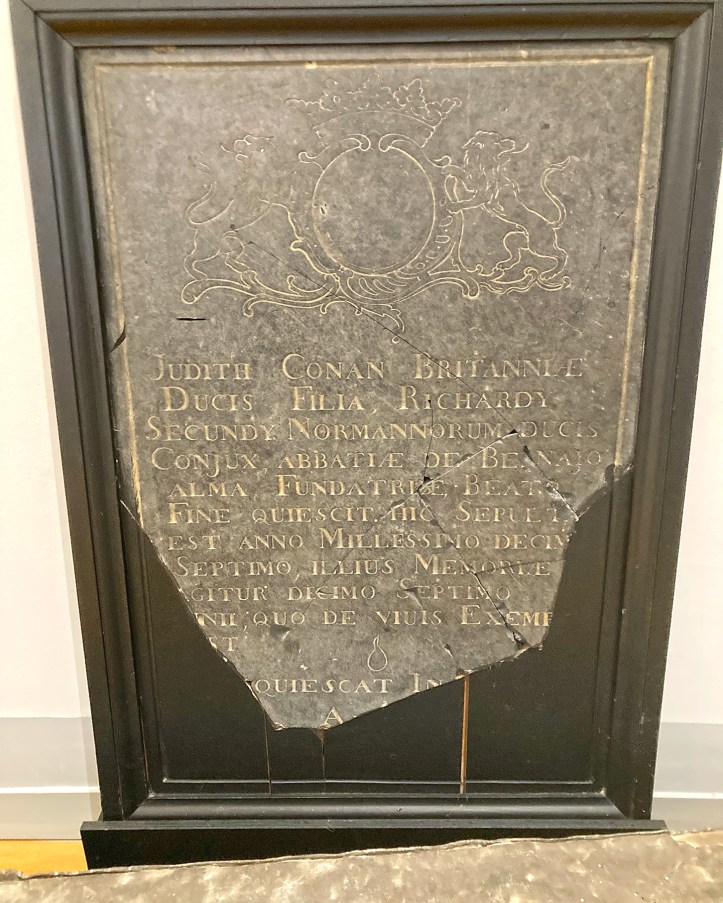
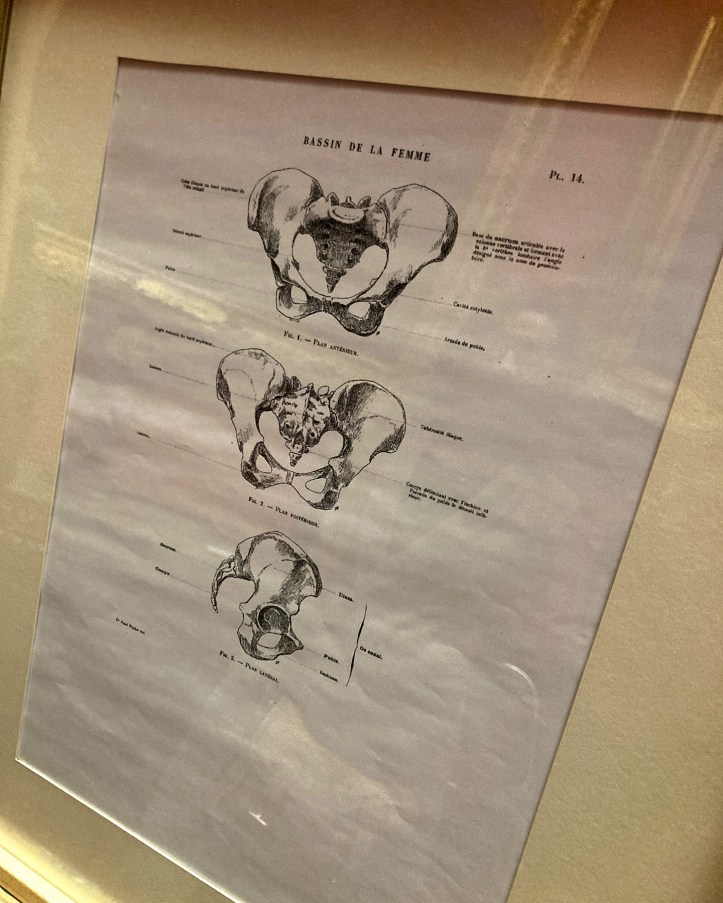
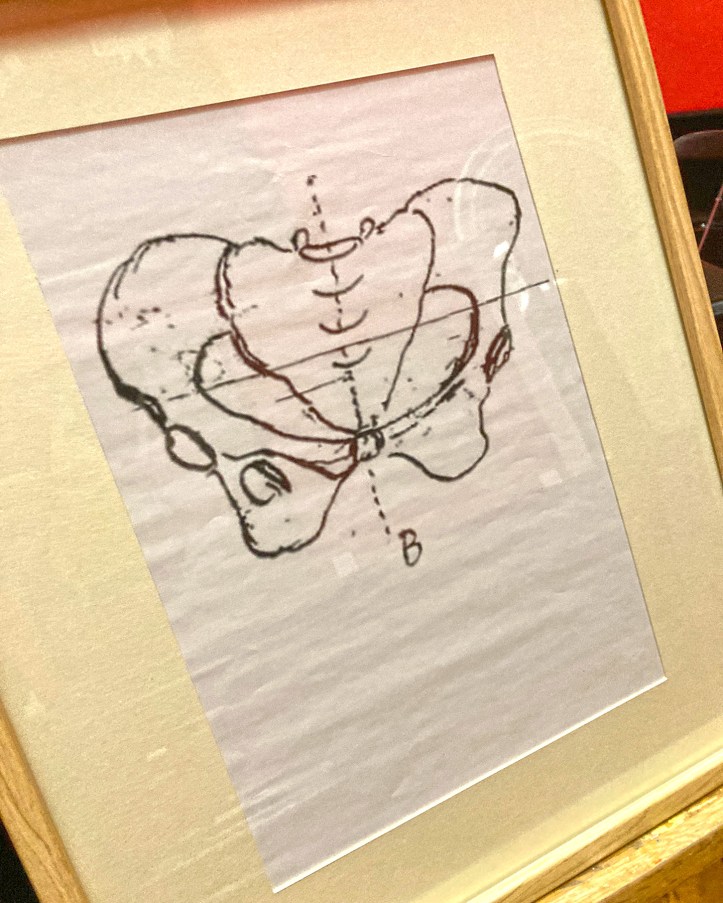
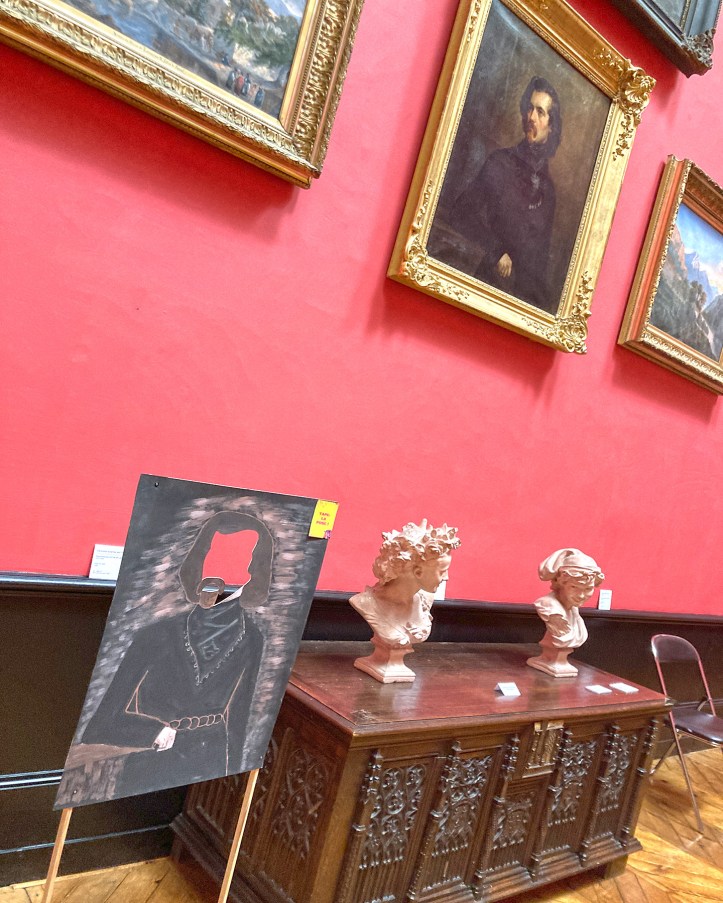
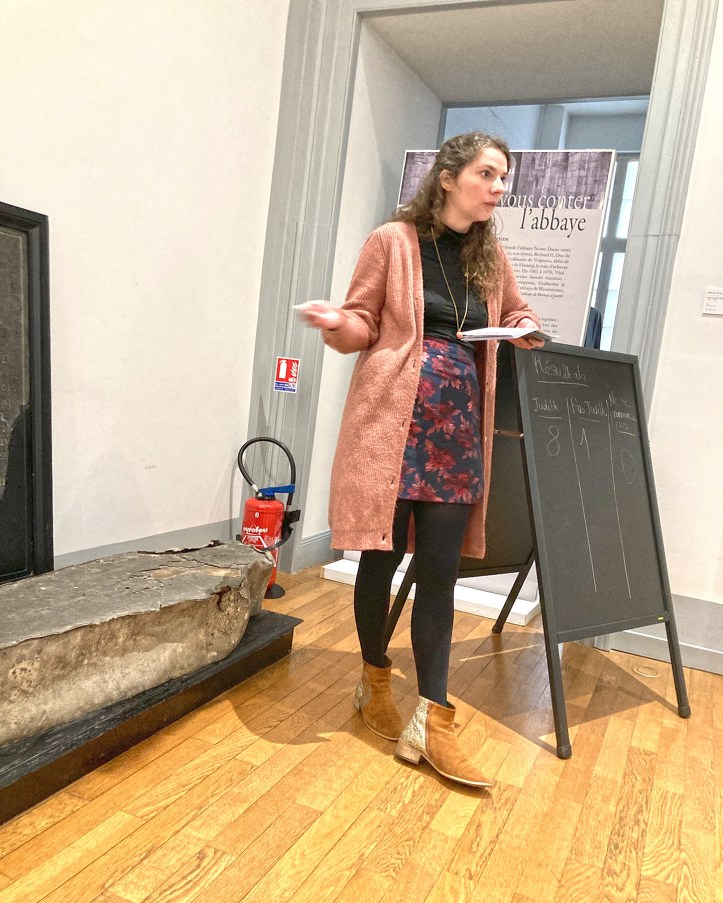
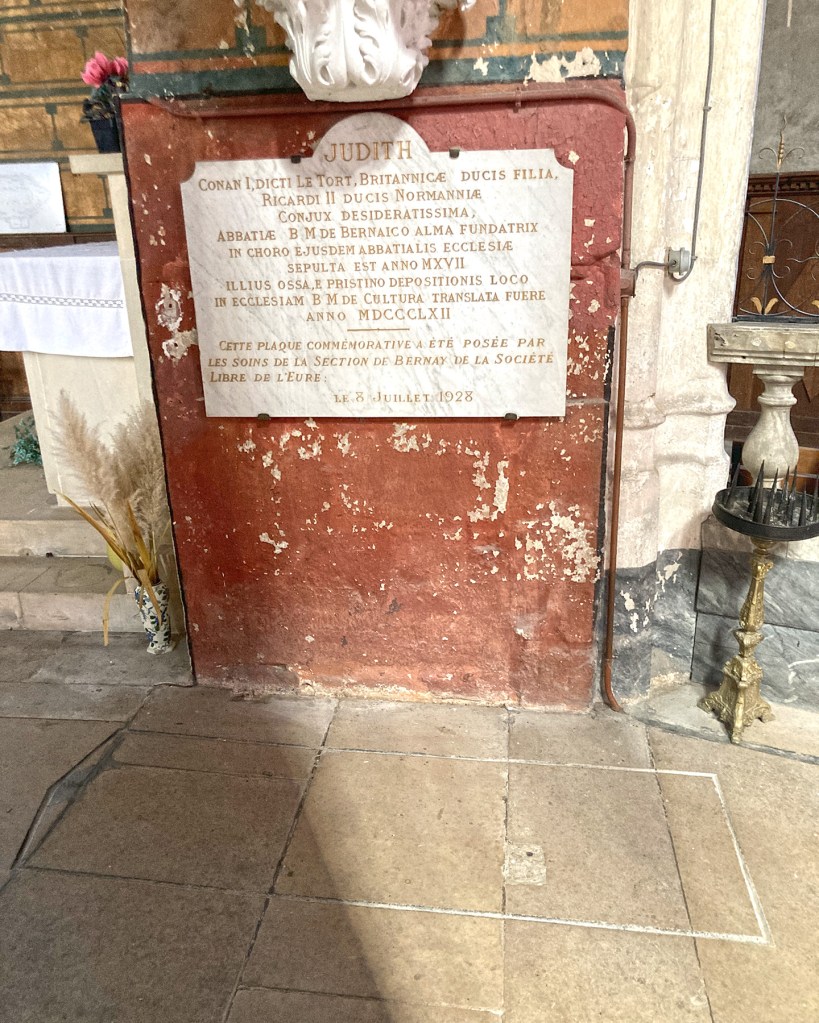
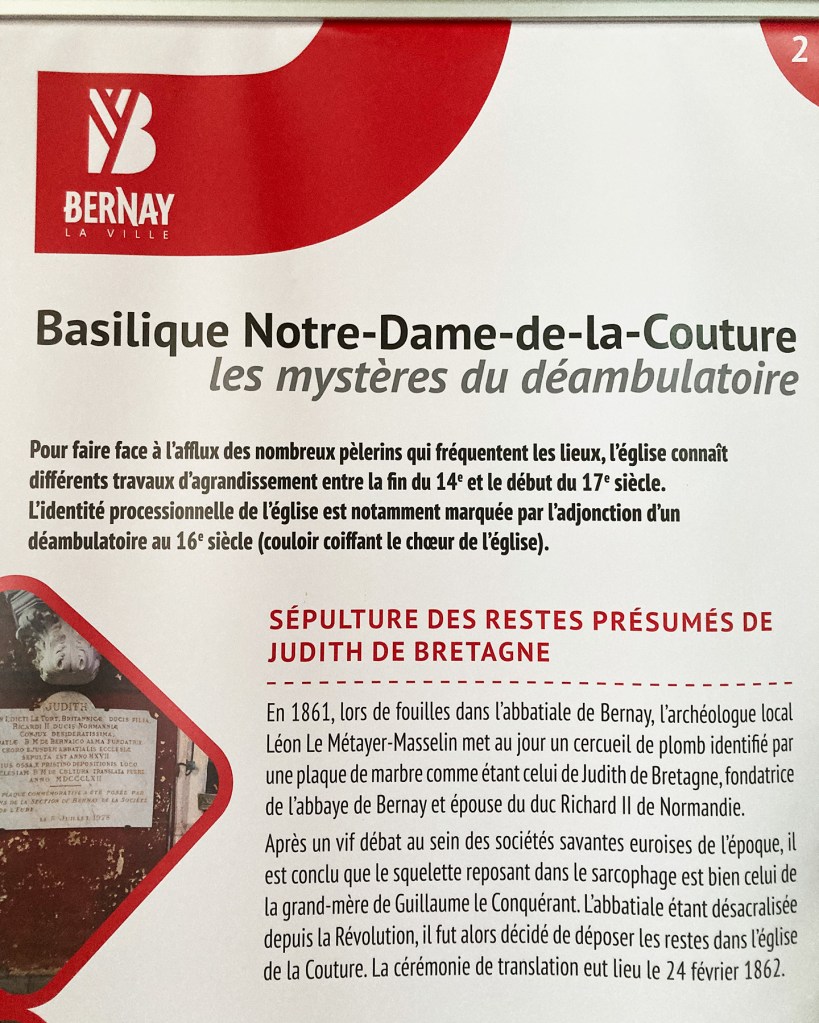
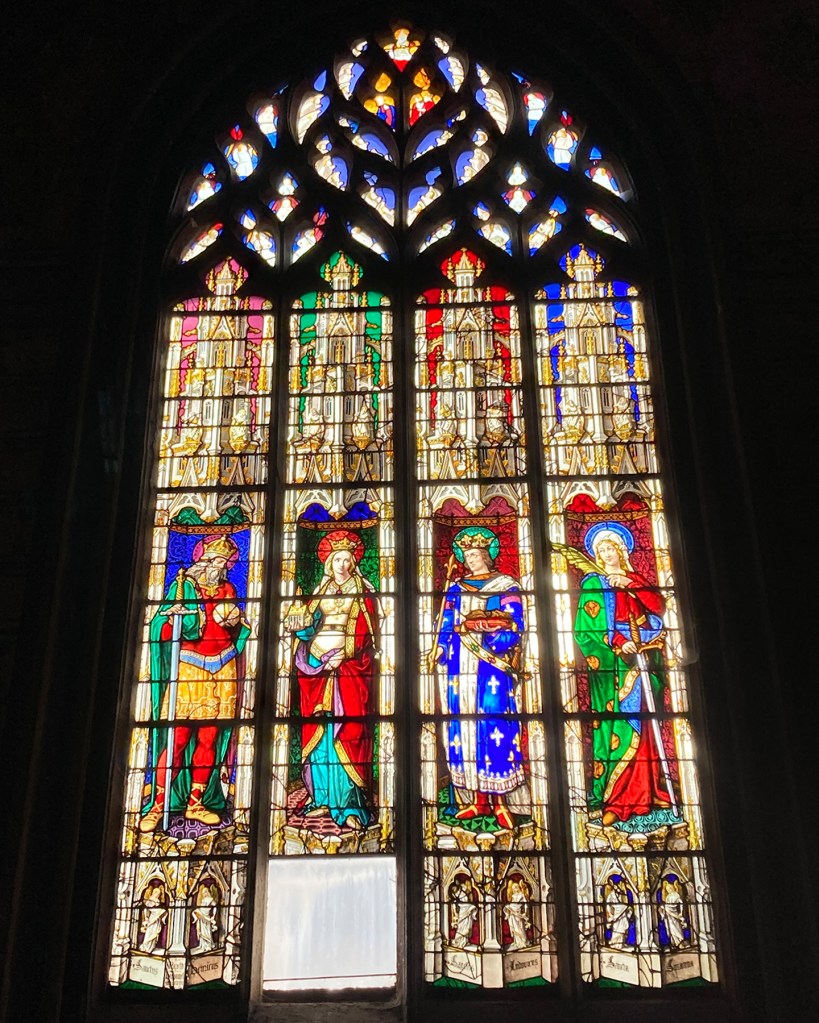
Pics: Detail of stained-glass window of JdB currently in the Lady of Sewing Basilica complete with sassy (?) hip slant; The handout we all got for the enquête; My co-enquêteur, the young man who read all of the clues to us; JdB’s sarcophagus and ledgerstone; Close-up on lead sarcophagus; Close-up on ledgerstone; This might belong to the BNF and I don’t know if I can use it but whatever; The drawing of JdB’s pelvis, malformation visible (?); Pierre-Victorien Lottin de Laval and the photo stand-in made for the kids; Mme Lambert herself; The ledgerstone and outline of JdBs new digs in the coeur of the basilica; A banner in the basilica that simultaneously says “the supposed remains of” and “it was decided that the remains are indeed those of JdB” (Precision, people); The full stained-glass window in the basilica.
Apparently, in 2018, the city and all concerned parties went through a massive rigamarole to have JdB exhumed and examined using carbon dating and other modern methods. But, after this huge coordinated effort, the request was denied by whatever administrative authority for mysterious reasons… >>> Update: The president of the Historical Society , Monsieur Montaggioni (historian, archeologist, and expert on the abbatiale) told me the reasons weren’t really that mysterious. There’s an archeology authority that decides what gets dug up based on criteria like whether it furthers historical knowledge, whether it needs to be dug up before a highway can be built over it, etc. And doing any archeological project requires a lot of money. Apparently JdB just didn’t cut the moutarde. 🫅🏻
* Our Lady of Sewing ?? 🤷🏼♀️ You tell me:
Un registre de 1777 recensant les métiers et le nombre de personnes les pratiquant permettant cependant d’avoir un juste aperçu de l’activité bernayenne. Il y apparaît que l’activité principale est consacrée à l’artisanat du textile avec notamment 88 rapiers, 91 compagnons drapiers, 38 toiliers et 56 marchands de frocs, toile ou drap. On trouve également 37 fileuses, 33 tailleurs d’habits, 9 couturières et 10 blanchisseuses. Au total, 66 personnes travaillent dans l’habillement (4 sabotiers, 38 cordonniers, 8 chapeliers, ou encore 3 modistes) … 7 tapissiers, 19 perruquiers. Source: Une petite histoire du commerce à Bernay
That’s a whole lotta sewing going on, right?
Musée des Beaux-Arts, Place de la République, Tel. 02 32 46 63 23, E-mail : musee@bernay27.fr
Winter hours (October-April)
1st weekend of every month only
Fri 19h-21h30
Sat/Sun 14h-18h
Winter vacation Tue-Sun 14h-18h
Summer hours (May-September)
Tue-Sun 14h-18h
 Bernay en anglais